The Business Owner’s Guide to Forklift Certification Requirements in 2025
Forklifts keep product moving, orders shipping, and jobs on schedule. They also add serious risk if people use them without training. For a busy owner, forklift certification can feel like one more form, but it is really a safety and compliance system.
In 2025, the core OSHA rules for forklifts are the same, but enforcement pressure is higher. Inspectors ask more often for training records, insurers want proof of programs, and online training tools are now common.
This guide explains who needs certification, what OSHA expects, how to set up a simple training program, and when to renew. The goal is clear: keep people safe, avoid fines, and protect your bottom line without turning training into a full-time job.
What Forklift Certification Really Means for Your Business in 2025

Forklift certification is not a government license. It is proof that your company trained and evaluated each operator on the forklifts they use and the conditions on your site.
When done well, certification does three things for your business. It lowers accident risk, it cuts legal exposure, and it keeps damage and downtime under control. You get fewer injuries, fewer bent racks, less product loss, and fewer surprise visits from OSHA after a serious incident.
Certification also shows customers and auditors that your operation is under control. Many large retailers, logistics firms, and manufacturers now ask vendors to show written forklift training programs before granting site access or contracts. In 2025, a clean training record can be the difference between landing work and getting passed over.
Forklift certification vs a regular driver’s license
A car driver’s license is not enough to run a forklift. Driving a forklift is more like driving a small rear-steer crane than a car.
Forklift certification is job training tied to the specific truck type and worksite. An operator must be trained and evaluated on the equipment they use, such as a sit-down rider, stand-up reach truck, pallet jack, or rough-terrain forklift. A person can hold a state driver’s license and still be unqualified to move a single pallet in your warehouse.
Certification also links to the employer. If a trained operator changes jobs, the new employer must review their skills and the new site conditions, then decide if more training or a fresh evaluation is needed.
Key OSHA rules every owner should know in 2025
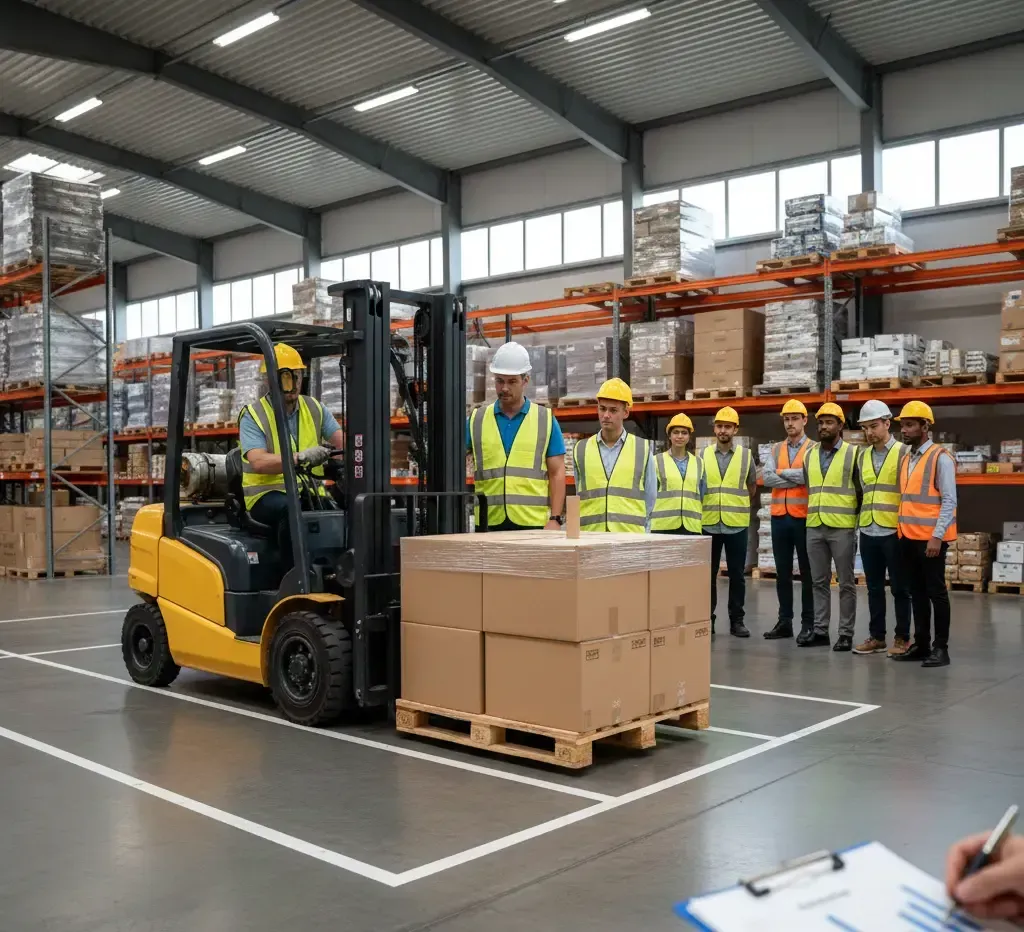
OSHA’s powered industrial truck rules require three basic pieces of training. You must provide formal instruction, practical hands-on training, and an evaluation of the operator’s performance in the workplace.
Formal instruction can be classroom or online. Practical training must include time on the actual or a similar truck. The evaluation must happen where the operator will work, with real loads and hazards.
OSHA does not issue forklift licenses or cards. The duty sits with the employer to train, evaluate, and document. After an incident or during an inspection, OSHA can ask to see those records.
Why compliance pays off: safety, fines, and reputation
Good forklift training leads to fewer tip-overs, strikes, and product drops. That means fewer workers’ comp claims and less equipment repair.
Compliance also shields you from expensive penalties. OSHA fines for repeat or serious violations can reach into six figures. In 2025, many insurers review safety programs before renewing policies or offering premium credits. Strong training records, clean inspections, and low claim history all help your reputation with insurers and key customers.
Do a quick safety check today.
Before you finish reading, take five minutes to review your current operator list— it’s the fastest step toward full compliance.
Step-by-Step Forklift Certification Requirements for Employers
You do not need a big safety department to meet OSHA forklift requirements. You need a simple, repeatable process that fits your size and industry.
Decide who needs forklift certification on your team
Any person who operates a forklift, even for a quick move, needs training and an evaluation. That includes full-time operators, part-timers, working supervisors, and leads who “jump on the truck” to help.
Temporary workers and staffing agency employees also need training that matches your site and equipment. You can share duties with the agency, but you still carry responsibility for safe operation in your facility.
Pedestrians, spotters, and floor staff who never touch the controls do not need operator certification. They still need basic forklift awareness so they know where trucks travel and how to stay clear. A good first step is a role review: walk through your site and list every person who ever drives a forklift.
Core training requirements: classroom, hands-on, and evaluation
OSHA’s model is simple:
- Formal instruction: Teach the rules and basic concepts. This can be in person or online. Key topics include load capacity, stability, speed control, blind spots, traffic patterns, and site rules.
- Hands-on training: Put each operator on the actual or a similar truck. Practice pre-use inspections, lifting and lowering, stacking, dock work, turning in tight aisles, and safe parking.
- Performance evaluation: Watch the operator run the truck in their real work area. Check how they handle loads, follow signs, use horns, and interact with pedestrians.
Training must use a language and style that workers understand. That can mean translated materials, slower pacing, or extra visuals. The evaluation is not just a quick drive. It is your chance to confirm that the person can work safely in your conditions.
Using online courses and third-party trainers in 2025
Many owners now use a mix of online theory and in-house hands-on practice. That approach saves classroom time while keeping the practical part close to your site.
Hiring a third-party trainer or buying an online course does not remove your duty. You still sign off that each operator is safe to run a truck in your facility. Treat outside providers as tools, not as a complete solution.
When you pick a provider in 2025, look for updated OSHA content, clear quizzes or tests, proof of completion, and support for the languages your workers speak. Ask if their materials cover the truck types you use and common hazards like docks, ramps, and narrow aisles.
Certification records you must keep (and what OSHA expects to see)
OSHA expects clear training and evaluation records. At a minimum, keep:
- Operator’s name
- Training date
- Evaluation date
- Type or class of truck used
- Name and signature of the trainer or evaluator
You can store records in a shared drive, an HR system, or a paper binder in the office. Wallet cards or badges help workers show status at the gate, but they are not the main proof. The real proof is your internal record that shows who was trained, on what, and when.
How often to retrain and recertify your operators
OSHA calls for an evaluation of each operator at least once every 3 years. Many companies also give refresher training at that time.
You must also provide extra training and a new evaluation after certain events. Common triggers include a forklift accident, a near miss, damage to a rack or truck, a change in the workplace layout, or the arrival of a new type of truck.
A simple example for a small warehouse: review records each January, schedule any 3-year evaluations for the first quarter, and add refreshers after any incident. That simple calendar keeps renewals from becoming a scramble.
Practical Tips to Build a Simple Forklift Safety Program

Certification works best when it fits into daily habits. A few steady practices can keep your program strong without a lot of paperwork.
Set clear site rules and forklift traffic patterns
People move safer when the path is clear. Mark main forklift aisles, set speed limits, and post no-pedestrian zones where loads block views.
Require horn use at blind corners, dock doors, and intersections. Set no-ride rules so no one stands on forks or rides on the side of a truck. Assign standard parking spots with forks lowered and brakes set.
Post simple rules at entry doors, near charging stations, and in break areas. Short, clear signs work better than long legal text.
Make inspections and toolbox talks part of the daily routine
Every shift, each operator should complete a pre-use inspection. That can be a short checklist that covers forks, mast, tires, brakes, horn, seat belt, and warning lights.
Track defects and lock out unsafe trucks until repaired. A simple tag system or log sheet can prevent a damaged forklift from quietly sliding back into service.
Add brief toolbox talks once a week or once a month. Five to ten minutes on topics like loading docks, blind corners, pedestrian safety, or battery charging can refresh what operators learned during certification.
Moving Forward with Safety
Forklift certification in 2025 is not just a card, it is a simple system that protects people, equipment, and profits. When you treat it as an ongoing process, it becomes part of how you run the business, not a separate project.
The core actions are clear. First, identify everyone who uses a forklift, even for short tasks. Second, set up training, evaluation, and records that match OSHA rules and your site conditions. Third, keep skills fresh with regular renewals, daily inspections, and short safety talks.
Pick one step this week, such as reviewing your current roster of operators or choosing a training method that fits your operation. Small, steady moves today can prevent the next serious incident tomorrow.
Get Your Team Certified
Secure your site and avoid fines. Schedule a call with our experts to start your certification process today.